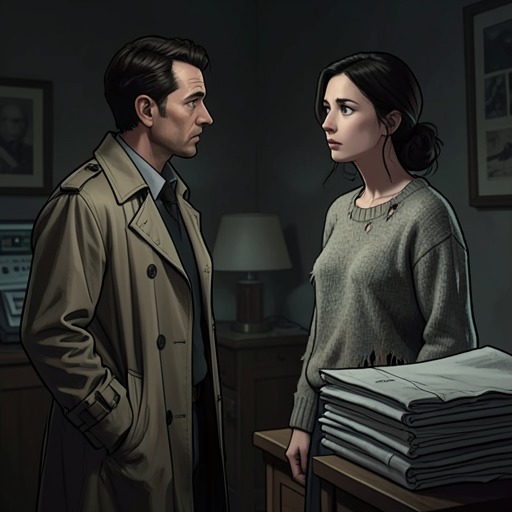
Lauren Freeman’s murder at Kissing Point
Crimson LakeLauren Freeman’s murder at Kissing Point is the event that led to Amanda Pharrell’s conviction and ten years in prison. The circumstances recalled in the novel make the crime’s setting and the uncertainty surrounding it inseparable: Amanda and Lauren were travelling to a party on the mountain, but they parked well away from it, along a dirt track in dense rainforest, and never arrived.
The Scene and Its Unanswered Questions
The police found Amanda thirteen hours later in the vehicle’s boot, while Lauren was in the back seat. Amanda’s clothes were nearby, soaked by overnight rain. Investigators found no footprints indicating that anyone else had come to the place where the car was parked. The distance from the party, the secluded parking spot, and the absence of evidence of another person left basic questions unresolved: why the young women had parked there, who knew they were there, and where the murder weapon was. Those gaps made Amanda’s initial account—that another person had killed Lauren while she remained in the boot—difficult for investigators to reconcile with the scene.
Amanda’s Account and the Case’s Aftermath
In her early interrogations, Amanda Pharrell first maintained that she had not killed Lauren Freeman and did not know who had. She then suggested that she knew who was responsible but would not identify that person, before briefly offering explanations involving a blackout, a dream, or seeing the killing through someone else’s eyes. Within days, she abandoned these explanations. Their succession left investigators with no settled account from Amanda to resolve the unanswered questions raised by the scene.
Valerie Gratteur, who examined Lauren, later said that whoever had killed her had hated her intensely in that moment. The observation described the apparent force of the attack but did not identify its perpetrator; Gratteur’s use of an uncertain attribution left open what the physical examination could establish about the killer’s identity.
The case ended in Amanda’s conviction for Lauren’s stabbing murder in 2004 and a ten-year prison sentence. That conviction became the defining public fact of Amanda’s past: by the time she opened a private-investigation agency in Crimson Lake, the newspaper account introduced her as the Kissing Point killer. The event therefore shaped both her imprisonment and the suspicion that followed her into her later work.
Evidence, Judgment, and the Partnership
The murder’s afterlife is also measured in what it does to Amanda Pharrell’s relationship with cars. When Ted Conkaffey asks why she travels by bicycle, she says she does not drive, not since that night. The terse answer connects her everyday practice to the event without supplying an explanation beyond the association itself: Kissing Point remains present in the routines of the life she has built after prison.
Ted’s response to the case is shaped by the precariousness of his own. He initially studies Amanda’s circumstances with suspicion, but recognizes that he knows only the surface of Lauren Freeman’s murder. He has himself been judged by a public relying on limited knowledge; although the charges against him were withdrawn during trial because the evidence could not properly satisfy a jury beyond reasonable doubt, he was never acquitted. That experience makes his scrutiny of Amanda ethically uneasy: he does not want to reproduce the same premature condemnation that has defined his own life.
The distinction between Amanda’s conviction and Ted’s unresolved accusation does not make their histories equivalent. Instead, their partnership brings two different forms of public judgment into proximity: a murder conviction that follows Amanda into her work, and a withdrawn case that still leaves Ted exposed to suspicion. The murder at Kissing Point thus matters beyond its immediate consequences for Amanda, becoming part of the novel’s examination of how legal outcomes, incomplete evidence, and public labels continue to shape people after the formal proceedings end.
Memory and the Limits of Reconstruction
The novel places the uncertainty surrounding Lauren Freeman’s murder within a wider pattern of evidence that cannot be cleanly separated from memory and interpretation. Ted Conkaffey describes his recollection of the roadside encounter with Claire Bingley as a composite assembled from what he remembers, trial testimony, newspaper accounts, things heard in jail, and possible fragments of nightmares. Witnesses placed his car at the bus stop at 12:47 p.m. and saw him speaking with Claire two minutes later, yet they could not agree whether his gesture toward her was a goodbye or an invitation to come closer; testimony about that gesture lasted three days. This episode does not resolve what happened to Lauren. Instead, its juxtaposition with Amanda’s case underscores the difference between establishing a legal outcome and recovering an uncontested account of events: the narrative keeps the questions around Kissing Point visible without claiming knowledge the evidence does not provide.